
How AegisOps works
Four inputs, explicit rules, a plan you can defend. AegisOps reads the state of the operation each day, applies the rules that matter, and produces a plan with the reasoning shown. It doesn't replace the planner — it gives the planner somewhere to stand. This page walks through what it takes in, how it reasons, and what it produces. Each input is read from it's source of truth and held current.
The Team
Every technician on roster — tickets, certifications, inductions, special authorisations, and recent work history, with compliance status visible at a glance.
The Vessel
Vessel capacity, operational sea-state limits, and the master's authority over the sail decision.
The Weather
A live offshore weather feed, summarised into usable windows, marginal calls, and days where revenue is best protected by leaving turbines to produce.
The Work
The task list for the windfarm, set against the site's full asset register. Turbine access, lifting equipment serviceability, balance of plant, grid connection status, and statutory inspection state all feed into the decisions the rules engine has to make.
How it Reasons
Every allocation AegisOps makes is the output of explicit rules, not a black-box model. The priority is simple: the right technician on the right job, with the most capable people on the most critical work — because that's what protects both the outcome and the people doing it. Where constraints would otherwise stop a job going ahead — an unresolved access issue, marginal weather, a lapsed certification — the rules surface the problem, attach the cost of the delay to it, and give the ops manager the evidence they need to unblock the day. Nothing happens that can't be explained. And no plan goes out to the team until a planner reviews and issues it — AegisOps recommends, a human owns.
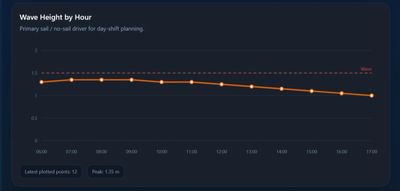
Wave height forecast with operational threshold, primary day-shift planning driver.

Compliance Visibility
Cert expiry, technical competency, and statutory inspection state are all tracked in real time. Where they would otherwise silently stall work, AegisOps surfaces them early and attaches them to the jobs they're holding up, with the deferred work costed day by day. Ops managers get the evidence they need to expedite inspections, accelerate training, and make the business case for the resources that keep work moving.
Capability matched to criticality, opportunity matched to the day
Not every job is equal, and not every technician is equal. AegisOps weights the most experienced leads and the most capable technicians toward the highest-priority work — the critical corrective, the outage-driving fault, the job that has to go right. On lower-stakes days, the same logic works in reverse: jobs that would otherwise default to the usual faces become genuine development opportunities for technicians growing into them, with the right support alongside. Capability gaps are tracked over time, so exposure to stretch work is visible — not accidental.
Team Composition
A team needs the right mix of skills and seniority for the job in front of it. AegisOps checks the composition of every proposed team and surfaces weaknesses before the sail — gaps in OEM training, missing specialist competencies, or a lead-to-support ratio that looks wrong for the task. Where the team can't be made right, the constraint is costed and attached to the job, so workforce gaps become a planning signal rather than a day-of surprise.
Weather windows, read in context
Sail status is more than a green-or-red call. AegisOps reads weather against the specific task and the equipment state of the turbine that will support it. A wind limit that's fine for a routine lift by davit isn't fine when the davit is out and an Actsafe becomes the only way to transfer equipment — the operational limit is adjusted accordingly, the task is deferred if needed, and the deferred revenue is attached to the blocker holding it up. A davit sitting unrepaired becomes a job whose priority rises daily, because the cost of leaving it is visible. The technician still makes the final call at the turbine.
Fairness Signals
Lead responsibility matters — not just for the work, but for how a team develops over time. AegisOps tracks consecutive lead days and lead frequency so rotation spreads evenly across the team rather than defaulting to the usual few. Secondary to capability and criticality, but visible to the planner, so fairness is demonstrable rather than assumed.
What Comes Out
AegisOps produces tomorrow's plan each morning, a provisional sketch of the day after, and today's live brief as work is underway. Each technician receives their own Pre-Sail Brief direct to their inbox — their team, their turbine, their tasks, the weather for their day. Planners work from the full console; technicians see what they need to know, and nothing they don't. Alongside the daily plan, the tool provides reference surfaces every role can reach: a site map of the asset, a per-turbine history that captures debrief notes as each job closes, and a technician roster that surfaces compliance status at a glance.
